The Five Elements (Wu Xing): A Complete Beginner’s Guide
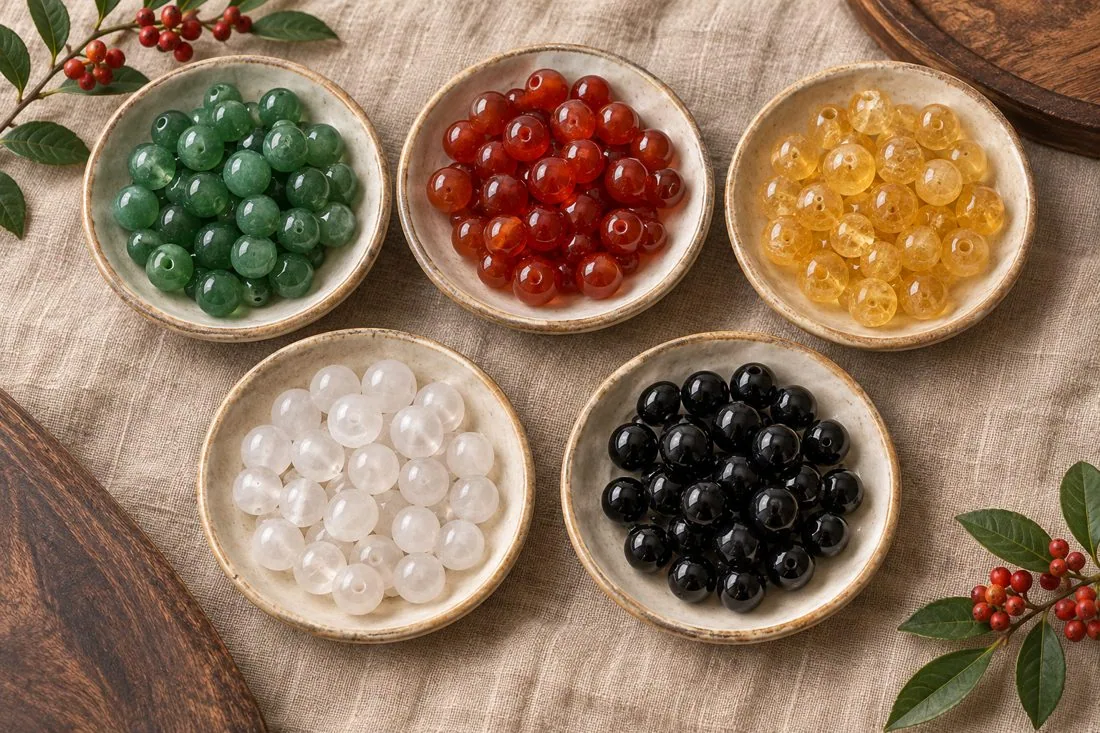
If you have ever read about acupuncture, feng shui, or Chinese astrology, you have met the five elements: Wood, Fire, Earth, Metal, and Water. In Chinese they are called wǔ xíng (五行) — and the standard English translation, “elements,” is quietly misleading.
The Chinese word xíng does not mean a static building block of matter, like the Greek four elements. It means movement, phase, conduct. A better translation might be “five phases of change” or “five transformative processes.” Where Western thought historically asked what is the world made of, the Chinese question was how does the world move.
This guide explains where the five phases came from, what each one represents, how they interact, and how to work out which phase is associated with your birth year. It is written for readers who are curious about the tradition itself — not a belief test, and not a substitute for medical, legal, or financial advice.
Where the Five Phases Come From
The earliest systematic description appears in the Hong Fan (“Great Plan”) chapter of the Book of Documents (Shàng Shū, 尚书), a compilation traditionally dated to the Zhou dynasty (roughly 1046–256 BCE). The passage lists the five — water, fire, wood, metal, and earth — each with its “taste” and function, as part of a manual of statecraft.
The scheme was not originally mystical. Early philosophers used it to classify everything under a shared vocabulary: seasons, directions, colors, tastes, organs, grains, planets, and political virtues. The historian Zou Yan (c. 305–240 BCE) of the Yin-Yang school is credited with developing the correlation into a full cosmology, in which dynasties themselves rose and fell according to the succession of phases.
By the Han dynasty (206 BCE–220 CE), the five phases were woven into medicine, calendrics, music, and government. Dong Zhongshu (董仲舒), the court scholar who shaped Han Confucianism, presented memorials to the emperor arguing policy through phase correspondences. From there the framework spread into nearly every layer of Chinese thought — including the feng shui and BaZi (八字, “eight characters”) birth-chart traditions that most Western readers encounter today.
The Five Phases, One by One
Each phase is a bundle of qualities rather than a substance. The classical correspondences below are the common core found across Chinese medicine and cosmology; individual schools vary the details.
Wood (木, mù)
Wood is spring energy: germination, extension, upward growth. Its season is spring, its direction east, its color green or cyan. In traditional Chinese medicine it is associated with the liver and the emotion of anger or frustration when blocked, and equanimity when flowing. Wood people, in the personality typologies, are described as decisive, expansive, restless to begin things.
Fire (火, huǒ)
Fire is summer energy: radiance, ripening, peak expression. Its season is summer, its direction south, its color red. It is associated with the heart and with joy — or agitation when excessive. Fire types are described as warm, expressive, and quick to connect.
Earth (土, tǔ)
Earth is late-summer energy: the pause between growth and harvest, digestion and distribution. Its direction is the center, its color yellow. It is associated with the spleen and with worry or, in balance, grounded empathy. Earth types are described as steady, nurturing, and mediating.
Metal (金, jīn)
Metal is autumn energy: contraction, refinement, letting go. Its season is autumn, its direction west, its color white. It is associated with the lungs and with grief — or, in balance, precise discernment and a sense of justice. Metal types are described as orderly, principled, and exacting.
Water (水, shuǐ)
Water is winter energy: storage, depth, stillness that precedes the next spring. Its season is winter, its direction north, its color black. It is associated with the kidneys and with fear — or, in balance, courage and wisdom. Water types are described as deep, patient, and strategic.
How the Phases Interact
What makes the system dynamic rather than a simple list are two cycles.
The generating cycle (相生, xiāng shēng). Each phase feeds the next: Wood burns to make Fire; Fire leaves ash that becomes Earth; Earth bears Metal in its ores; Metal collects Water through condensation on cold surfaces; Water nourishes Wood. In this loop, each phase is “mother” to the one it produces.
The controlling cycle (相克, xiāng kè). Each phase restrains another: Wood breaks up Earth; Earth dams Water; Water extinguishes Fire; Fire melts Metal; Metal chops Wood. In a healthy system — a body, a garden, an organization — generating and controlling forces hold each other in check. Imbalance in either direction is what classical diagnosis looks for.
These two cycles are why a practitioner discussing your chart or your living space will rarely talk about a single element in isolation. The question is always the pattern: which phase is deficient, which is excessive, and what the knock-on effects are.
How to Find Your Element by Birth Year
In BaZi, the full system uses your year, month, day, and hour of birth, each expressed as a pair of characters — the famous “eight characters.” But there is a widely used first approximation based on the heavenly stem (天干) of your birth year alone:
| Last digit of birth year | Heavenly stems | Element |
|---|---|---|
| 0 or 1 | Gēng (庚), Xīn (辛) | Metal |
| 2 or 3 | Rén (壬), Guǐ (癸) | Water |
| 4 or 5 | Jiǎ (甲), Yǐ (乙) | Wood |
| 6 or 7 | Bǐng (丙), Dīng (丁) | Fire |
| 8 or 9 | Wù (戊), Jǐ (己) | Earth |
Two cautions. First, the year in this system changes at the solar term of Lì Chūn (立春, the beginning of spring, around February 4), not on January 1 — so if you were born in January or early February, you belong to the previous year. Second, this year-stem method is genuinely only a first approximation. A full BaZi chart frequently shows a “day master” of a different element, and the interesting readings come from the interactions among all eight characters, not from the headline element.
If you would like to go deeper than the year-stem shortcut, our masters offer full BaZi readings with a written report.
How People Actually Use This Today
The tradition survives in modern practice in three main forms, and it is worth knowing which one you are looking at:
Feng shui analyzes spaces through phase correspondences — the colors, materials, and directions of a room — and suggests adjustments meant to support the occupant’s intentions. Practitioners describe their work in terms of balance and harmony; claims that object placement guarantees specific life outcomes are not part of the classical tradition, and reputable modern practitioners do not make them.
Traditional Chinese medicine uses the phases to organize diagnostic relationships between organ systems. TCM is a regulated medical modality in many countries, and anything touching health belongs in a conversation with a qualified practitioner — not a bracelet, and not a blog post.
Personal practice — the lane we work in — is cultural and intentional rather than medical or predictive. Many people wear a crystal or bead bracelet aligned to a phase they want to be mindful of, the way one might keep a stone on a desk or a quote on a wall: a physical reminder of an intention, in a tradition three thousand years old. Our own Five Elements collection is made in exactly this spirit.
Common Questions
Is the five elements framework a religion? No. It is a natural-philosophy framework that predates organized Daoism and Confucianism and was adopted by both. It makes no claims about gods or worship.
Is wu xing the same as yin-yang? They are complementary frameworks that Han-era thinkers fused. Yin-yang describes a binary of qualities (shady/sunny, receptive/active); the five phases describe five kinds of process. In mature Chinese cosmology, every phase also has its yin and yang aspects.
Which element am I “supposed” to be? In the classical view, there is no ideal element — only patterns of balance and imbalance. This is a real difference from Western astrology’s “what’s my sign” framing.
Do I have to believe anything to use it? No. Plenty of people wear five-element jewelry the way they practice calligraphy or drink tea at a certain hour: as a cultural rhythm with a pleasing logic, no metaphysics required.
A Note on Sources and on Honesty
The classical references in this article — the Book of Documents, Zou Yan, Dong Zhongshu, the Huangdi Neijing (Yellow Emperor’s Inner Canon, the foundational medical text that carries the phase correspondences into diagnosis) — are the standard scholarly anchors for this subject, and any library with a Chinese philosophy section will carry translations and commentaries.
What we will not do on this site is tell you that a bracelet will change your fortune, cure anything, or protect you from harm. No tradition, Eastern or Western, honest about itself, promises that. What the five phases offer is older and quieter: a vocabulary for noticing patterns — in seasons, in spaces, in yourself — and for setting intentions within that vocabulary. If that is what you are looking for, you are in the right place.
By the DaoYi Studio Editorial Team. This article was reviewed for accuracy by our resident masters. Corrections and questions are welcome through our contact page.
Disclaimer: Content on this site is for cultural and educational purposes. It is not medical, legal, or financial advice, and it is not a substitute for consultation with qualified professionals.